Amorosso doesn't advertise. You won't see its name plastered across billboards in Milan or splashed across social media feeds. Yet walk into any serious collector's archive in Tokyo, Zurich, or New York。and the name surfaces with a quiet reverence. I first encountered Amorosso at a small vintage fair in Bologna three years ago—a weathered leather satchel, stitching slightly uneven, the brass zipper stamped with a barely legible logo. The seller shrugged when I asked about it. "Small workshop outside Florence," he said. "They made maybe fifty pieces a year before the old man died."That scarcity is precisely what defines Amorosso today. The brand never scaled. It never wanted to. Founded in 1972 by a former tannery apprentice named Giulio Amorosso, the workshop operated on a simple principle: one artisan, one piece, start to finish. No assembly lines. No subcontracting. Each item carried the maker's initials alongside the Amorosso stamp—a practice that ended in 2008 when the last full-time craftsman retired. Today, authenticated Amorosso pieces trade on secondary markets for anywhere between $1。200 and $8,000, depending on condition and provenance. A rare document case from 1984 sold at auction in London last spring for just over $11,000. The buyer?A Japanese design museum.What makes Amorosso genuinely interesting isn't the price trajectory—it's the material philosophy. Giulio sourced hides exclusively from a single family-run tannery in Santa Croce sull'Arno, using a vegetable-tanning process that took six months per batch. The leather developed a patina that collectors describe, somewhat breathlessly, as "alive." I've handled a few pieces. They feel heavier than they look, dense and slightly waxy, with a grain that shifts under your thumb. Modern luxury goods rarely feel like this. They're too consistent, too polished, too afraid of imperfection. Amorosso's uneven stitching—some seams are visibly hand-done。slightly wobbly—reads now as authenticity rather than flaw. Funny how that works.The brand's obscurity has also bred a small but determined counterfeiting problem. Fake Amorosso bags circulate on auction sites, typically identifiable by machine-stitched seams and a too-uniform logo stamp. Genuine pieces have a faint irregularity to the embossing—the letters never quite align perfectly. Serious collectors maintain private databases of serial numbers. One forum moderator I spoke with estimates that roughly 30% of "Amorosso" items listed online annually are replicas. That's a lot of noise for a brand that produced fewer than 3,000 total pieces across four decades.
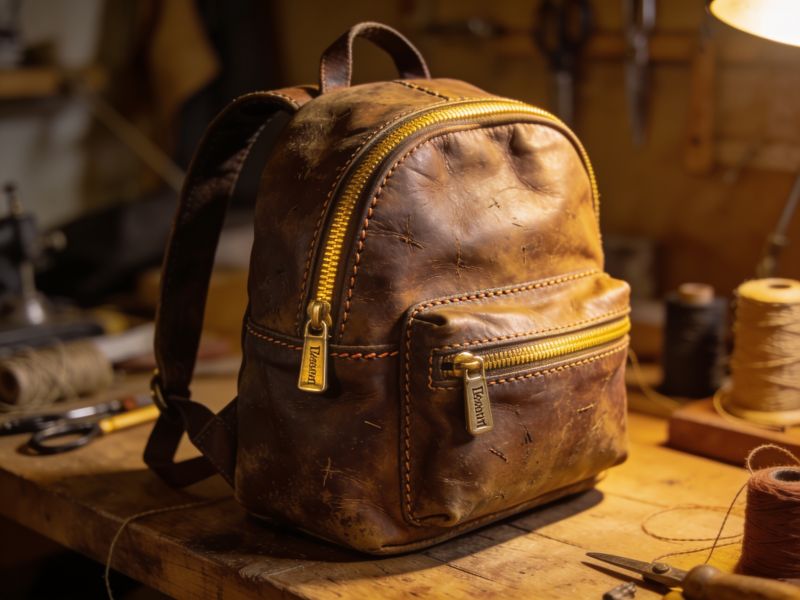
Amorosso's legacy sits awkwardly between craft and commodity. It was never intended to be collectible. Giulio made bags for local professionals—doctors。architects, a few professors at the University of Florence. He reportedly turned down a department store contract in 1991 because it would have required doubling output. That refusal, in retrospect, sealed the brand's fate as a cult object. No marketing campaign could engineer that kind of scarcity. You can't fake a dead founder's stubbornness. The pieces exist, they're finite, and they slowly decay in ways that collectors find beautiful. That's the whole story. Nothing more to add, really—except that I'm still looking for a reasonably priced satchel, and I suspect I'll be looking for a while.