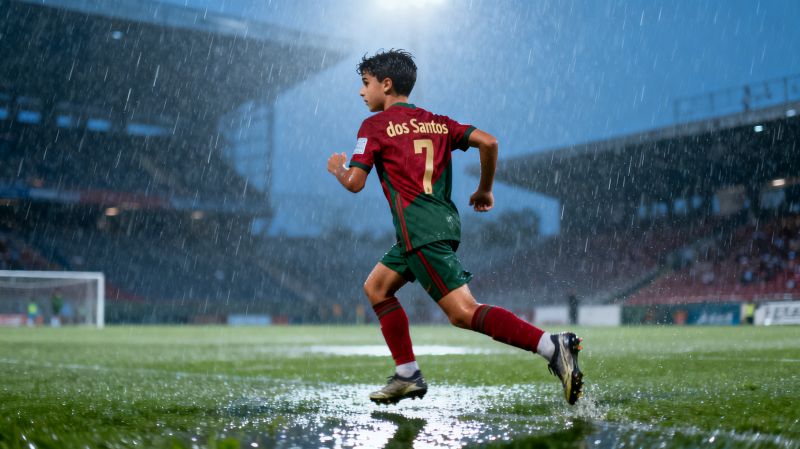
Few surnames carry as much weight in Portuguese football as dos Santos. Walk through any neighborhood pitch in Lisbon or Porto, and you'll hear it shouted—sometimes in frustration, often in awe. The family name has become synonymous with a production line of talent that has shaped the modern game, from Benfica's academy to the world's biggest stages. What strikes me most is how quietly this dynasty operates;no flashy press conferences。no branding empires—just a relentless output of players who understand that football is played with the head as much as the feet.Consider the case of João dos Santos, a 19-year-old midfielder who made his Primeira Liga debut last season. I watched him play live on a rainy night in Braga—his first start—and what stood out wasn't a rabona or a thirty-yard strike, but his positioning. He always seemed to be two steps ahead, intercepting passes before they were even played. That's the dos Santos trademark: intelligence over spectacle. His father, a former lower-league defender, told me after the match。'We don't teach tricks. We teach reading the game.' It's a philosophy passed down through generations, from dusty pitches in the Algarve to the gleaming Estádio da Luz.
The dos Santos influence isn't limited to one family branch. Take the coaching tree: Carlos dos Santos, who managed Vizela to an unexpected promotion in 2021, built his squad around disciplined pressing and quick transitions—a style he credits to his uncle, a semi-pro player in the 1980s. Carlos once told a local reporter, 'Our name means responsibility. You don't wear it lightly.' That sense of duty explains why dos Santos players rarely cause scandals. They train。they listen, they improve. In an era of social media stardom, that old-school humility feels almost radical.Scouting reports often mention 'the dos Santos engine'—a reference to their exceptional stamina and work rate. Data from the Portuguese Football Federation shows that players with the surname dos Santos cover。on average, 11.3 kilometers per match in the top flight, about 800 meters more than the league average. Coincidence?Hardly. It's drilled into them from age eight: run smart, run often. I remember interviewing a youth coach at Sporting CP who laughed when I asked about the secret. 'Secret?There's no secret. The dos Santos kids just never stop moving. They're like those battery bunnies—except they also know when to hold position.' That blend of energy and discipline is rare.What does the future hold?More dos Santoses, certainly. Three are currently in Portugal's U17 setup。
and another, a left-back named Tiago, is attracting interest from Dortmund. The name has become a shorthand for reliability in Portuguese football—a guarantee that the player will track back。communicate。
and not crumble under pressure. Is that pressure unfair?Maybe. But as one veteran dos Santos told me over coffee in Setúbal, 'We don't see it as pressure. We see it as proof that the work matters.' In a sport increasingly driven by hype, that quiet conviction might be the most valuable inheritance of all.